
THE KARMUWALA TIMELINE
A story carried through time.
From the banks of the Beas to lives across continents.
01 River & settlement
Founding date unrecorded
Village tradition
Founding of Gharka Village
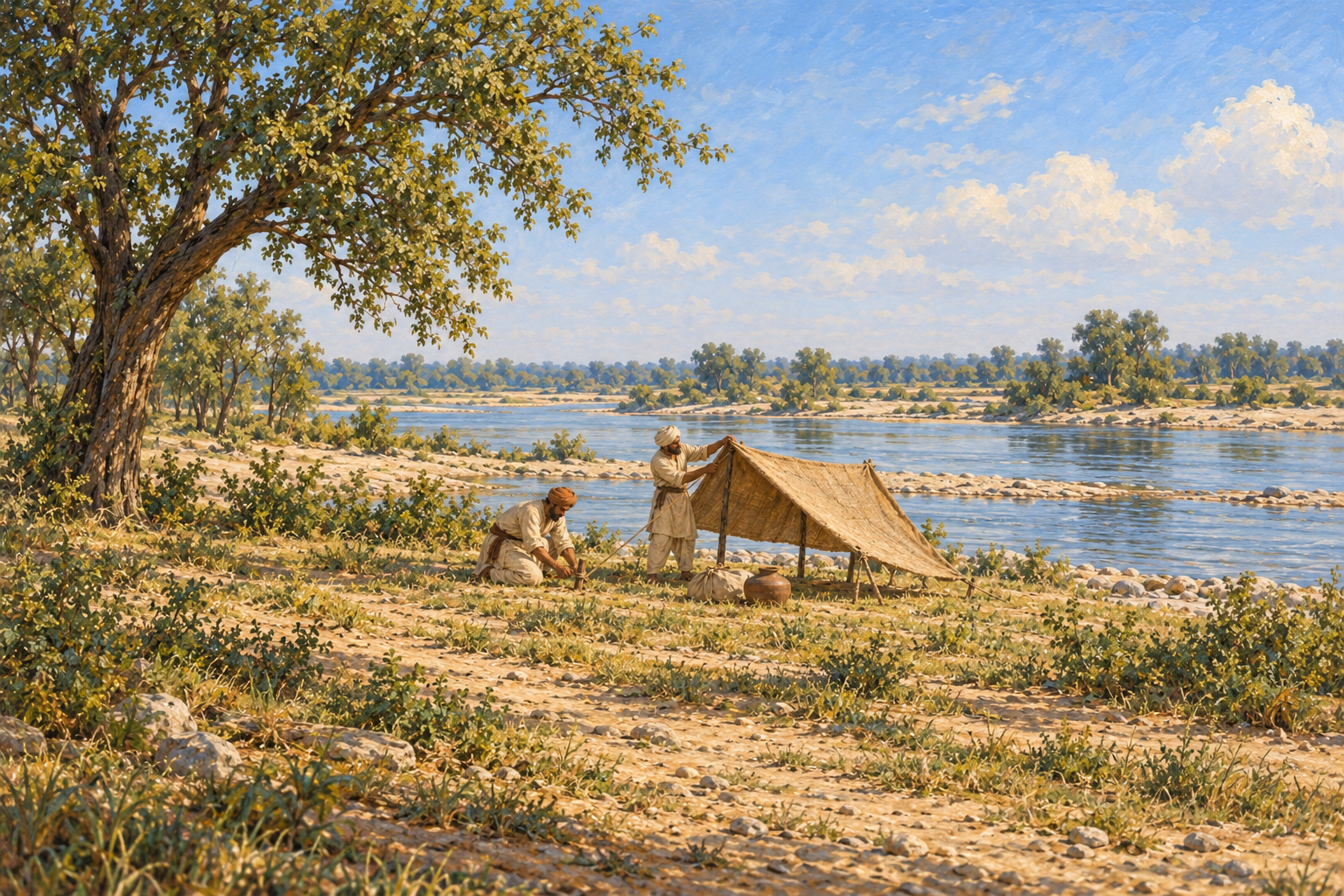
Village tradition remembers Gharka and Chamba as brothers who established a camp beside the Beas. The same tradition names three other brothers: Rurka, Varnala and Ghariala.
Sources and note
Kirpal Singh and Harinder Kaur, Punjab de Pindan da Namkaran ate Itihas (Punjabi University, Patiala, 2014), pp. 113–114, entry 14, “Chamba Kalan (Gharka Chamba)”. This later village history records the riverside camp and the brothers’ names without giving a founding date. The illustration is interpretive.
Mughal period
Village tradition
Dispersal of the brothers
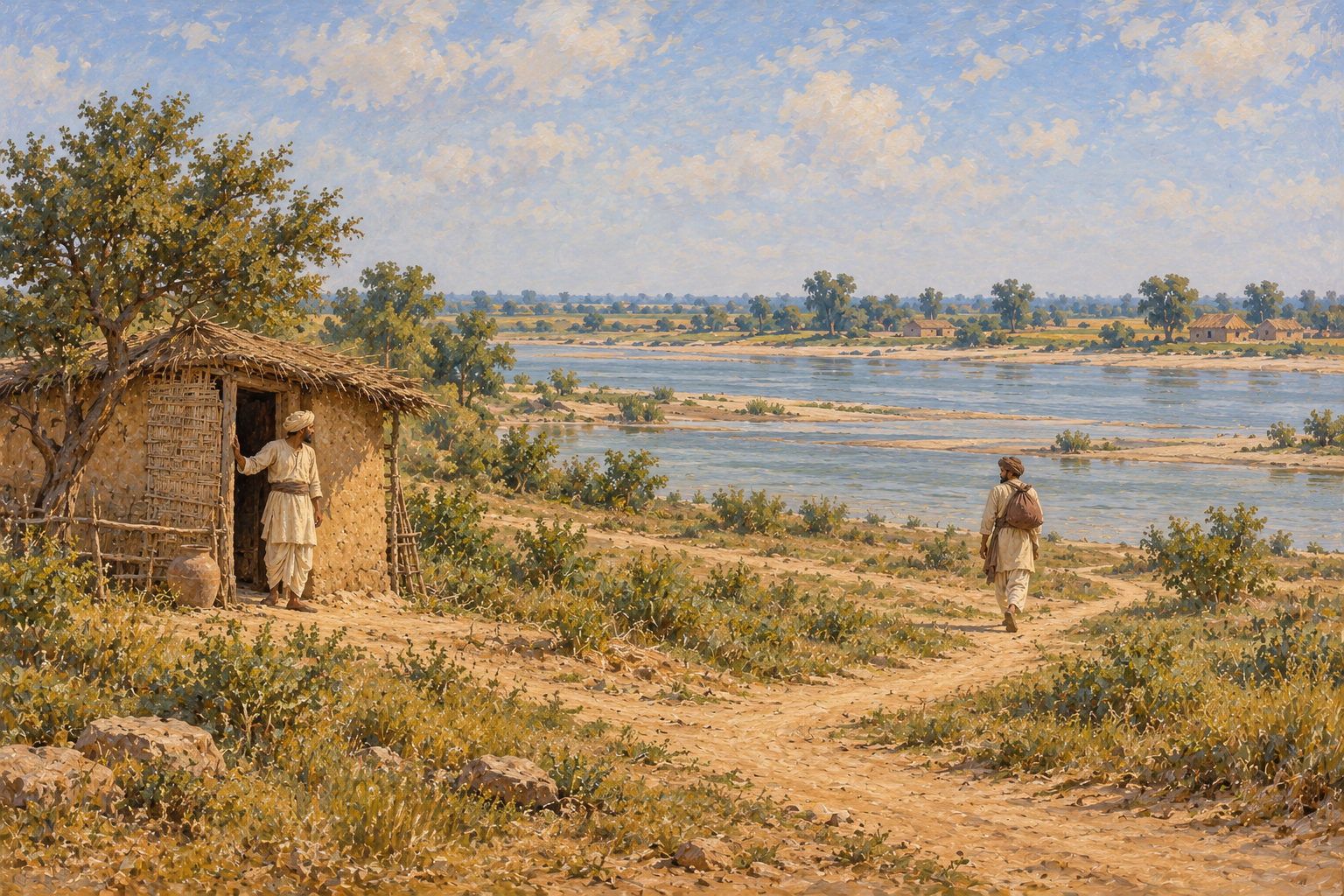
In the village tradition, Varnala and Ghariala converted to Islam during the Mughal period and left the riverbank to establish villages bearing their names. Gharka remained while Chamba founded a separate settlement on an abandoned village site beside the river. As the river changed course, Chamba’s residents moved near Gharka and later farther away, forming Chamba Kalan.
Sources and note
Kirpal Singh and Harinder Kaur, Punjab de Pindan da Namkaran ate Itihas (Punjabi University, Patiala, 2014), pp. 113–114, entry 14, “Chamba Kalan (Gharka Chamba)”. The phrase “ਮੁਗਲਾਂ ਦੇ ਸਮੇਂ” (“during the Mughal period”) places Varnala and Ghariala’s conversion and move in that broad period; it gives no specific reign or years. The later settlement and river relocations are undated. This is a later village-history account. The illustration is interpretive.
Late 1798
A report of violence, later linked to Gharka
In late 1798, while Shah Zaman, king of Kabul and Kandahar, was at Lahore, he sent a detachment against Khureaheh and Purwaheh after a complaint that their landholders had carried off cattle from another village. The contemporary account reports that both villages were destroyed, their inhabitants “put to the sword”, and the troops returned with plunder. Khureaheh’s proposed identification with Gharka remains uncertain.
Sources and note
A translated Punjab news report preserved in National Archives of India, Foreign Department, Political Consultations, 11 January 1799, Nos. 28 and 28-A, describes the episode. The report’s opening names Shah Zaman; No. 28-A, viewer p. 4, contains the village passage. Late 1798 is the report’s historical setting, not an exact incident date. Hari Ram Gupta, History of the Sikhs, volume III, Trans-Sutlej Sikhs 1769–1799 (1944), pp. 108–110, proposed that Khureaheh was “Ghurka”, twelve miles south-east of Patti. The manuscripts do not themselves establish that equation or a casualty count.
1800s–1820s
Date under review
Formation of Karmuwala
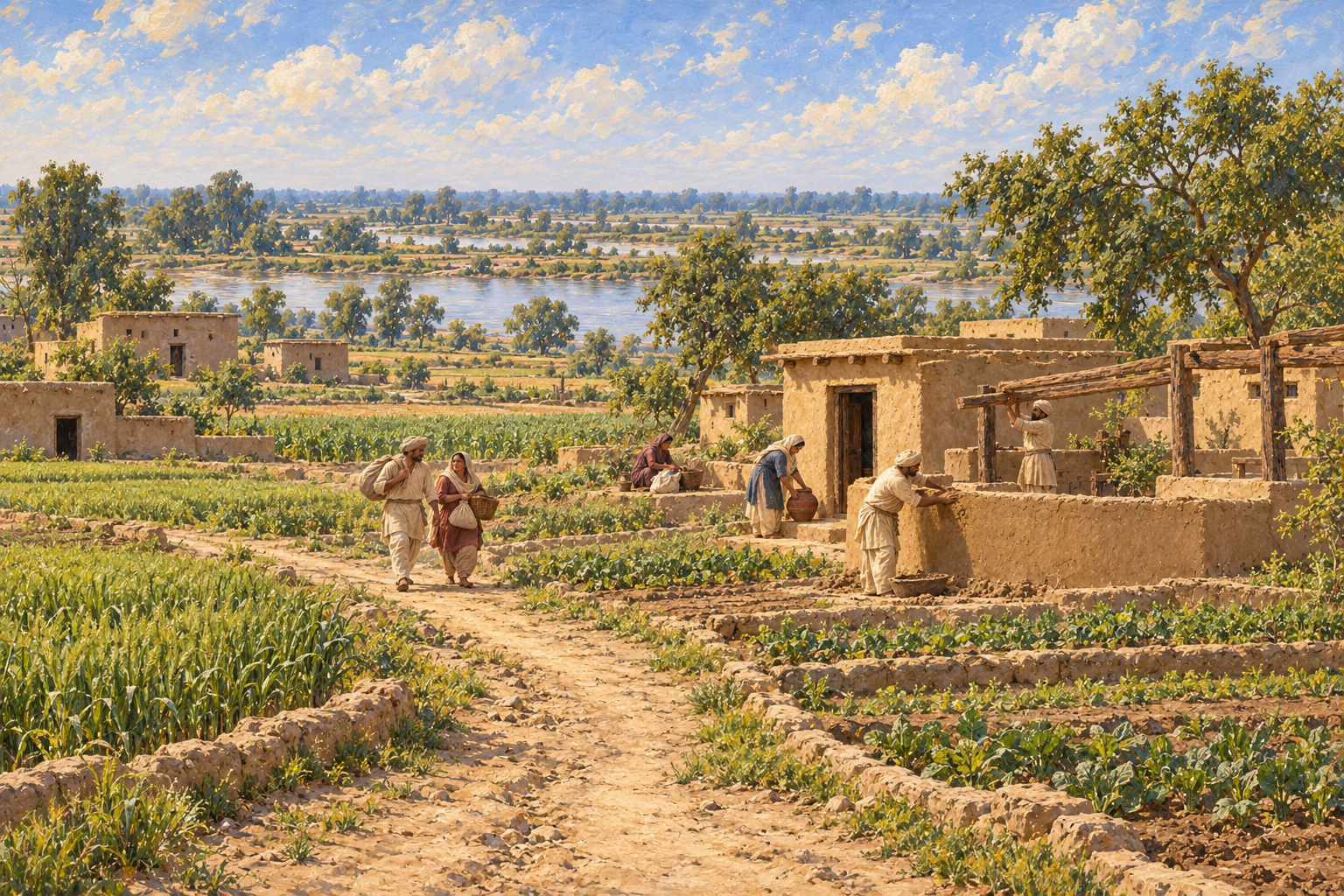
Families from Gharka moved to Karmuwala, then a patti within Gharka, to live closer to their fields. Further households joined them, and the settlement gradually became a distinct village.
Sources and note
The account comes from the village’s settlement tradition. The 1800s–1820s range is retained from the earlier Timeline and remains under review; it should not be read as a verified founding date.
02 Journeys overseas
1850–1856
Bhai Maharaj Singh is imprisoned in Singapore
Bhai Maharaj Singh, a Sikh leader who resisted British rule in Punjab, was brought to Singapore as a political prisoner in 1850, along with Bhai Kharak Singh. They were among the earliest recorded Sikhs in Singapore and were held at Pearl’s Hill Prison, later known as Outram Prison. Maharaj Singh died in captivity in 1856.
Sources and note
SG101’s “Silat Road Sikh Temple” records Maharaj Singh’s arrival as a prisoner in 1850, imprisonment at Pearl’s Hill and death there in 1856. NLB’s “Bhangra”, PDF p. 1, names Bhai Kharak Singh alongside him; it draws on Surjan Singh’s They Died for All Free Men, p. 18. NLB’s Outram Prison article explains the prison’s earlier Pearl’s Hill name. These official historical summaries support the years used here, not an exact arrival day. “Earliest recorded” is deliberately cautious, not a claim that no Sikh ever reached Singapore earlier. This is wider Singapore Sikh context, not evidence of a Karmuwala or family connection.
1881
The Sikh Police Contingent is introduced
On 26 March 1881, 54 Sikh recruits arrived from Punjab to join the police in Singapore. This marked a new phase of Sikh settlement after the arrival of political prisoners in 1850.
Sources and note
Ang Seow Leng, “Men in Blue: A History of the Singapore Police Force”, BiblioAsia, 10 October 2015, section “The European, Sikh and Gurkha Contingents”, dates the European recruits’ arrival to 25 March 1881 and the arrival of an assistant superintendent and 54 Sikhs from Punjab to the following day. The figure 54 refers to that arrival, not the contingent’s later strength. H. Miller, “The Straits Settlements Police”, Singapore Free Press Centenary Number, 8 October 1935, Section 1, pp. 16 and 18, also records the introduction of European and Sikh contingents in 1881. For the earlier political prisoners, see the 1850–1856 entry.
1894
Sunder’s Singapore business begins

Sunder Singh, also known as Racha Singh, was doing business in Singapore by 1894. The earliest known migrant from Karmuwala, he represents another strand of the village’s overseas story: a business career alongside the better-known route through police service. He later became a founding member and the first president of the Sikh Money Lenders Association.
Source and note
The Straits Times, 7 March 1951, p. 8, explicitly states that Sunder began business in Singapore in 1894. His position as the earliest known migrant from Karmuwala is a conclusion of the village and family research, not a statement in the obituary or an exhaustive account of every migrant. The notice does not establish his exact arrival date, personal voyage or whether he had previously served in the police.
03 People & service
1913
Birth of Massa Singh

Massa Singh Sandhu was born in Karmuwala, Punjab, in 1913, the son of Bhan Singh and Esher Kaur.
Sources and note
Massa’s British passport description page records Karmuwala and 1913 as his birthplace and birth year. His parents’ names are family information; the family identifies the passport’s Pan Singh with Bhan Singh. The passport issue date is not established.

15 Feb 1915
Start of Sepoy Mutiny in Singapore
On 15 February 1915, a large part of the 5th Light Infantry mutinied in Singapore during the First World War.
Sources and note
Hansard, House of Lords Debates, 2 March 1915, volume 18, column 605, “The Regimental Riot at Singapore”. The Secretary of State for India explicitly dated the outbreak to 15 February. This was an early official statement before the fuller investigation; its account of causes is not adopted here.
27 Dec 1915
Sunder’s earliest written mention traced so far
The earliest written mention of Sunder Singh traced so far appears in a Christmas-fund notice published on 27 December 1915, listing him as a contractor and a donor of $25 to the Malay States Guides’ Christmas fund.
Sources and note
The Straits Times, 27 December 1915, p. 8, contribution list. This is the earliest contemporary written mention traced so far in the research. The contractor is attributed to the Karmuwala Sunder Singh with high confidence, but the identification is inferred; the earliest explicit village-qualified notice traced is dated 2 March 1918. The Ebden fund total of $214 belongs to this same notice and is not Sunder’s donation, which was $25. The date shown is the notice’s publication date, not a separately established donation day.
Circa 1915–1916
Birth of Hardit Singh
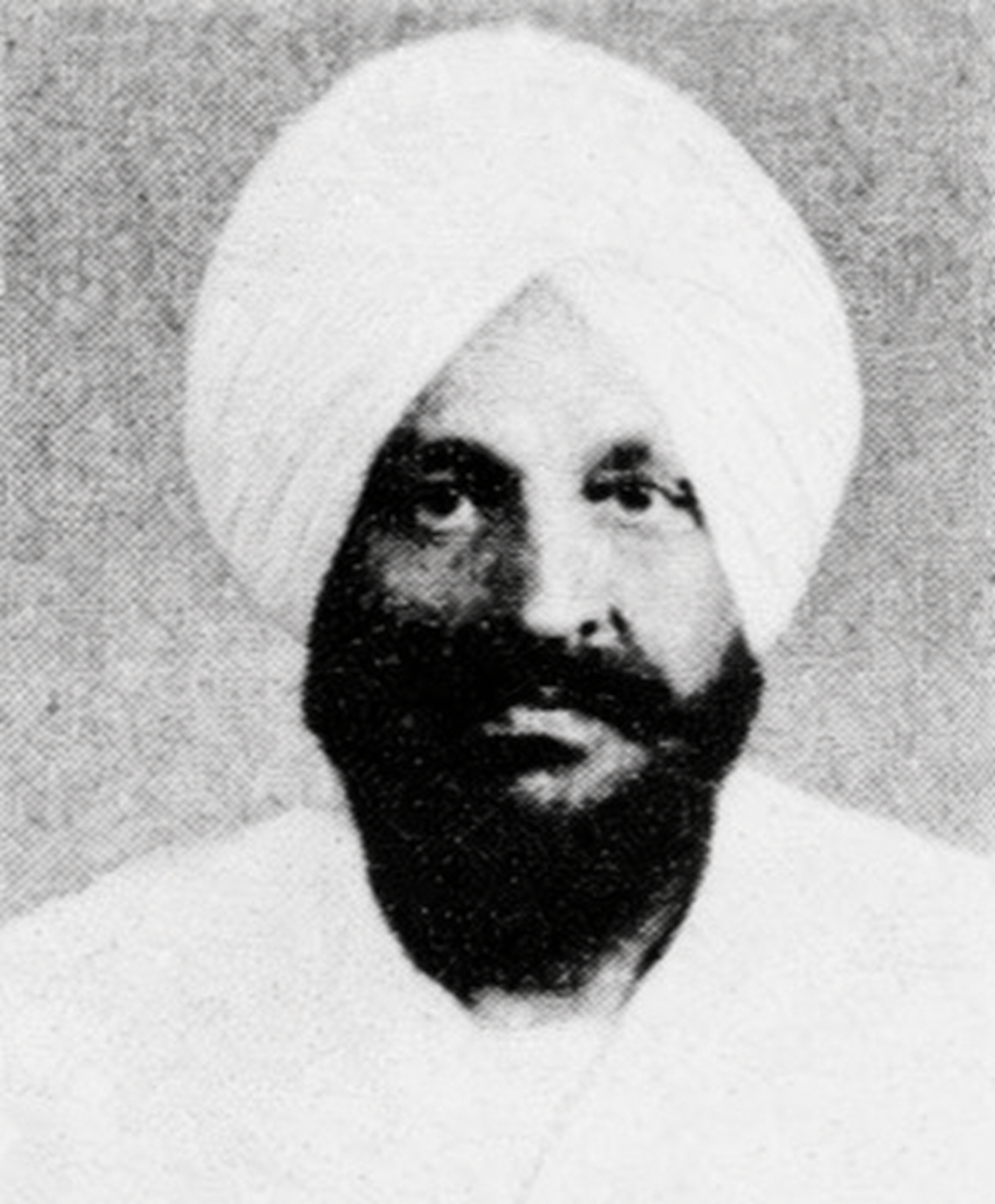
Hardit Singh, Sunder Singh’s son, was born in Singapore around 1915–1916. The family’s roots were in Karmuwala, Punjab.
Sources and note
Hardit’s letter of 8 March 1961, Appendix II, B28–B29, records his Singapore birth. His death notice, The Straits Times, 12 April 1976, p. 27, gives his age as sixty; no exact birthday is established. The father–son relationship is explicitly recorded in the Straits Settlements Government Gazette, 26 June 1936, p. 1630, GN 1764.
Apr 1916
Sunder Singh joins the Sikh Advisory Board
Sunder Singh, then described as a contractor, was named among the members of Singapore’s Sikh Advisory Board in April 1916.
Sources and note
Malaya Tribune, 29 April 1916, p. 9, “Local and General”; also Government Gazette, 28 April 1916, p. 613, Notification 495. These are publication dates, not a separately established first day of service. The early contractor entry is attributed to the Karmuwala Sunder Singh with high confidence; the notice alone does not supply the fuller family identification found in later records.
Possibly 1916–1917
Ranga Singh arrives in Singapore
Ranga Singh, son of Pal Singh of Karmuwala, moved to Singapore, possibly in 1916 or 1917. His exact arrival date remains unconfirmed.
Sources and note
The arrival recollection is attributed only to “J Singh”. The speaker’s full identity, testimony date and original recording or written statement remain unidentified. A separate family-supplied requiem clipping names Ranga as the son of Pal Singh and identifies Village Karmuwala; it does not establish the arrival date. No public link to the original arrival testimony is available.
By August 1922
Sunder serves as vice-chairman
Sunder Singh Karmonwalia was listed as one of the Sikh Advisory Board's two vice-chairmen, marking a further stage in his community service in Singapore.
Source and note
Straits Settlements Government Gazette, 4 August 1922, p. 1016, GN 1289. The notice records his office; it does not establish the day he first took it up.
July 1932
The Sikh Money Lenders Association is registered
A registration order for the Sikh Money Lenders Association was made on 28 July 1932. Sunder Singh was a founding member and its first president.
Sources and note
The registration notice appeared in the Gazette on 26 August 1932; it names no officers. Sunder's founding role and first presidency are recorded in his 1951 obituary, not dated by the registration notice.
Straits Settlements Government Gazette, 26 August 1932, p. 1570, GN 1649; The Straits Times, 7 March 1951, p. 8.
25 October 1934
Sunder is acquitted
Sunder Singh, also known as Racha Singh, was acquitted and discharged after the prosecution offered no evidence in a false-evidence case. The charge had been reported earlier that year.
Sources and note
The Straits Times, 25 October 1934, p. 23, subsection “No Evidence Offered”; earlier charge report in the Singapore Free Press, 23 June 1934, p. 6. The outcome was an acquittal, not a conviction.
2 May 1936
Hardit Singh appointed to the Sikh Advisory Board
Hardit Singh was appointed as a member of the Sikh Advisory Board with effect from 2 May 1936, replacing his father, Sunder Singh, who had resigned.
Circa 1937
Family recollection
Massa begins work at Changi Prison
Massa Singh is believed to have begun work as a guard at Changi Prison around 1937, about the time it opened. His arrival in Singapore remains uncertain, but he was serving at Changi by November 1941.
Sources and note
Family recollections place the start of Massa’s guard work at Changi around 1937; this is not an independently verified appointment date. The National Museum’s collection entry dates the prison’s official opening to 1937, but that institutional date does not establish Massa’s service. His November 1941 letter to the Superintendent, H.M. Prison Changi, identifies him as P.G.195 and is the earliest contemporary employment evidence identified. The letter’s header day is damaged, and it gives no arrival or appointment date.

2 October 1938
Hardit joins the Indian Association committee
Hardit Singh was elected to the Indian Association’s committee at its annual meeting.
Sources and note
Morning Tribune, 3 October 1938, p. 3. The meeting date of 2 October follows the report’s reference to “last evening”. The family identifies the printed Hardit Singh as Hardit Singh Sandhu of Karmuwala; the newspaper does not itself supply that full identification.
1940
Sunder retires to India
Sunder Singh retired to India in 1940 after decades of business and community service in Singapore.
Source and note
Hardit Singh's letter dated 8 March 1961, printed in the Select Committee report on the Queen Street and Silat Road Sikh Gurdawaras Bill, Appendix II, Paper S.C. No. 16, B28–B29. This is retrospective family testimony, not a contemporary departure record.
June 1942
Hardit's Indian Independence League work
Hardit was named on the Indian Independence League’s local working committee in Syonan (Singapore), and among Malaya’s delegates to the Bangkok Conference, held from 15 to 25 June 1942.
Sources and note
The committee notice appeared on 4 June 1942, p. 2. The NAI Bangkok Conference Report, original PDF pp. 139–140 and 146–147, spells the delegate’s name “Hardat Singh”. The family identifies both entries with Hardit Singh Sandhu. The conference dates do not establish his precise attendance or travel dates, and neither record establishes an INA rank or military command.
By August 1949
Hardit leads the Sikh Moneylenders' Association
Hardit was president of the Sikh Moneylenders' Association by August 1949. A published letter defending the association's members carried his name alongside that of secretary Kartar Singh.
Source and note
“Sikh Moneylenders Answer Their Critics”, The Straits Times, 15 August 1949, p. 4. This attests his presidency, not the date he was elected.
February 1951
Hardit serves the Central Sikh Temple
Hardit was listed as honorary treasurer of the Central Sikh Temple, adding temple administration to his work in Singapore's Sikh community.
Source and note
“Sikh Temple Officials”, The Straits Times, 13 February 1951, p. 4. The report records the office; it does not establish the exact day his service began.
March 1951
Sunder's death is reported
By March 1951, Sunder Singh, also known as Racha Singh, had died in India, aged eighty. He had built a Singapore business career from 1894 and served as the Sikh Money Lenders Association’s first president.
Source and note
The Straits Times, 7 March 1951, p. 8. This is the date of the report; the notice gives no exact death day.
1955–1957
Hardit chairs the Sikh Advisory Board
Hardit served as chairman of the Sikh Advisory Board during 1955–1957. He also began a further two-year term as a board member on 6 May 1955.
Sources and note
Government Gazette, 6 May 1955, p. 616, GN 1198, establishes the membership appointment. The chairmanship dates come from Hardit's letter of 8 March 1961, not from the Gazette.
8 March 1961
Hardit writes on gurdwara administration
Hardit set out his views on the administration of the Queen Street and Silat Road gurdwaras in a letter to the Select Committee considering their amalgamation bill.
Source and note
Letter dated 8 March 1961, Select Committee report, Appendix II, Paper S.C. No. 16, B28–B29 / PDF pp. 45–46.
May 1962
Hardit is elected Advisory Board chairman
By May 1962, Hardit had again been elected chairman of the Sikh Advisory Board, following his earlier chairmanship in 1955–1957.
Source and note
“Sikh Board”, The Straits Times, 10 May 1962, p. 18. The report gives no exact election day.
October 1970
Hardit prepares for an Asian rally
Beyond his business and community work, Hardit was named as navigator in a team preparing to leave for an Asian rally.
Source and note
A. Johnson, “Friendship” team leave today for Asian rally, The Straits Times, 17 October 1970, p. 29. The report describes a proposed journey, not proof that the rally was completed.
11 April 1976
Hardit Singh Sandhu dies
Hardit Singh Sandhu died on 11 April 1976, aged sixty. Born in Singapore to a family from Karmuwala, he had served the Sikh Advisory Board and other community organisations over several decades.
Sources and note
The Straits Times death notice of 12 April 1976, p. 27, records death on 11 April, age sixty and “Karmuwala” beside his name. His Singapore birth is recorded in his letter of 8 March 1961. The Gazette of 26 June 1936, p. 1630, GN 1764, and the later sources elsewhere in this Timeline document his long community service. The notice’s address is not a stated place of death.
31 August 1980
Massa Singh Sandhu dies
Massa Singh Sandhu died on 31 August 1980, after a working life in Singapore that included prison service, taxi driving and watchman work.
Sources and note
The Straits Times, 31 August 1987, p. 30, seventh-anniversary remembrance, states “Departed 31st August 1980”. The publication date is distinct from the death date. His November 1941 Changi letter establishes prison service, and Violet Oon’s “A turbanned head in the lion”, New Nation, 12 April 1972, p. 2, describes daytime taxi driving and night watchman work.